
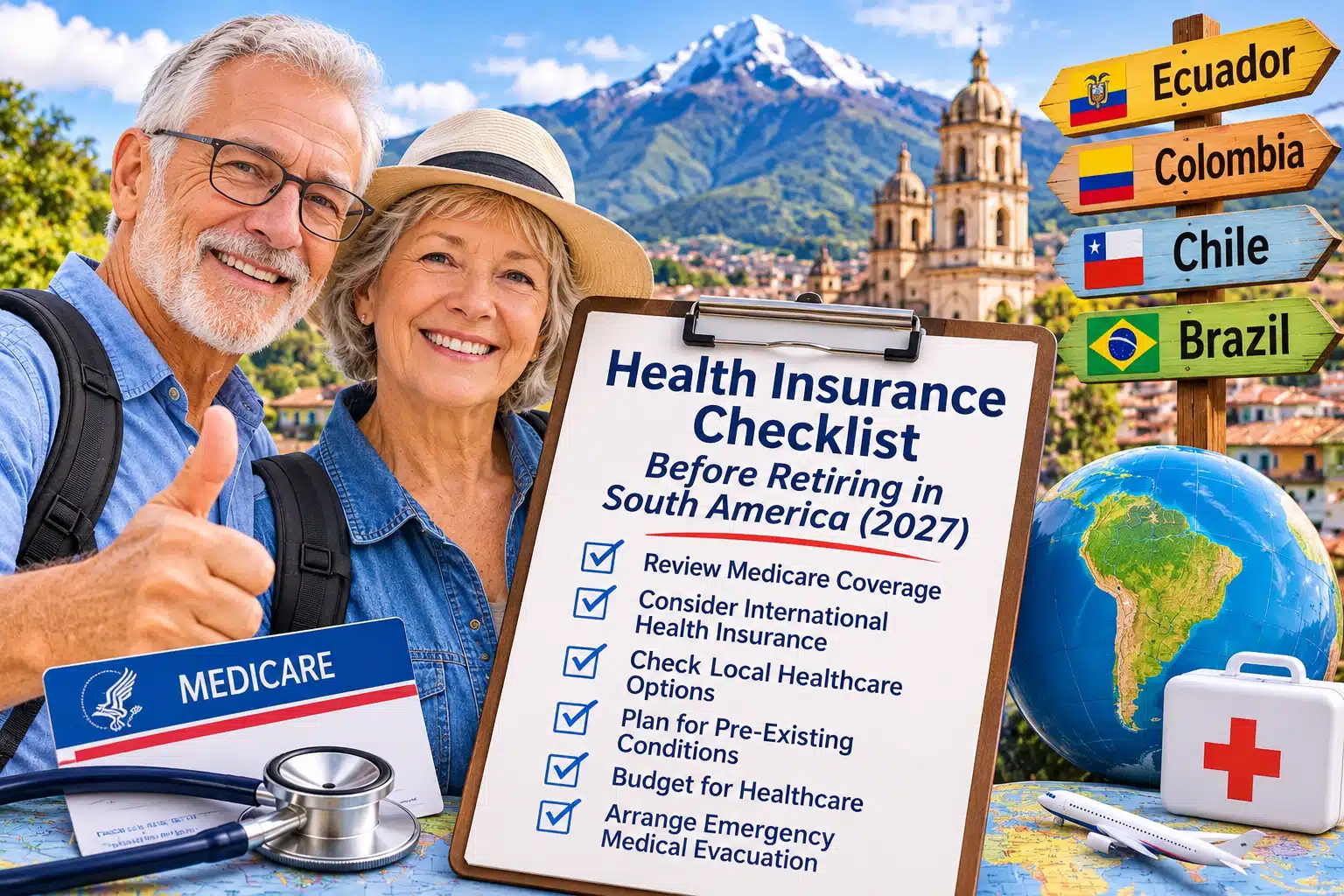
Retiring to South America can stretch your savings a long way, but health insurance is where a lot of otherwise well-planned moves go sideways. People drop Medicare Part B and get hit with a lifetime penalty later. They buy a cheap travel policy that their residency visa won’t accept. Or they arrive in Cuenca or Medellín with no coverage for the months it takes to qualify for local insurance.
This checklist walks you through every health insurance decision in the order you’ll need to make it, from a year before you move to your first six months abroad. Use it as a road map, and follow the links for the deep dives.
The Short Answer
The five decisions that matter most:
- Decide what to do about Medicare — especially Part B — before you leave, because dropping it can mean a permanent late-enrollment penalty if you ever come back.
- Choose your country, then read its visa insurance rule. Most residency visas require proof of health insurance valid in that country.
- Line up coverage that starts the day you land, usually international health insurance, until you qualify for local options.
- Plan your long-term setup: a local public or private plan, international insurance or a combination.
- Add an evacuation plan if you want a guaranteed way back to a US hospital after a serious illness or accident.
Your Timeline at a Glance
| When | Focus | Key actions |
|---|---|---|
| 12–6 months before | Big decisions | Medicare strategy, choose a country, research visa insurance rules, set a health budget |
| 6–1 months before | Buy and document | Buy international coverage, get medical records and prescriptions, finish US care |
| Moving week | Switch over | End US plans that won’t work abroad, confirm new coverage starts, pack medical documents |
| First 6 months abroad | Settle in | Get residency ID, join local coverage, find doctors, decide whether to keep international insurance |
12 to 6 Months Before You Move: The Big Decisions
1. Decide what to do about Medicare
Original Medicare generally doesn’t pay for care outside the US, so the question isn’t whether it will cover you in Ecuador or Colombia — it won’t. The question is whether to keep paying for it.
- Part A is premium-free for most people with enough work history. Keep it.
- Part B costs $209.40 a month in 2027 for most people. If you drop it and re-enroll later, the late enrollment penalty adds 10% to your premium for each full 12-month period you were without it, for as long as you have Part B. You can generally only re-enroll during the General Enrollment Period, January through March, with coverage starting the next month.
- Medigap policies can include a foreign travel emergency benefit (80% after a $250 deductible, during the first 60 days of a trip, up to $50,000 for life), which helps on trips but isn’t coverage for living abroad.
- Part D and Medicare Advantage generally don’t work abroad, and dropping Part D can trigger its own late penalty if you return.
Many expats keep Part B as insurance for the possibility of returning to the US. Others drop it to save money. There’s no right answer for everyone, but make the decision deliberately. Read our guides on whether to keep Part B, the Part B late enrollment penalty and Medigap foreign travel coverage.
2. Pick your country — and read the visa’s insurance rule
Each country’s residency visas handle health insurance differently:
| Country | What the visa typically requires |
|---|---|
| Ecuador | National or foreign health insurance valid for the same period as the visa; a foreign policy must state it covers you in Ecuador |
| Colombia | Coverage requirements vary by visa; the digital nomad visa requires a policy naming seven specific coverages in Colombia |
| Peru | Requirements vary; sources disagree on whether the rentista visa formally requires insurance |
| Chile | Some guides report a minimum coverage requirement for the retiree visa; confirm with SERMIG |
| Brazil | Visa rules vary by consulate; the nomad visa requires insurance valid in Brazil for the whole stay |
| Argentina | Non-resident foreigners must now carry insurance; confirm rules for your residency visa |
Read the specific requirement before you buy any policy. See our country guides and how health care works in South America.
3. Understand what local coverage will be available to you
In several countries, legal residents can join the national system for far less than private insurance:
- Ecuador: voluntary IESS membership at 17.6% of declared income, with a monthly minimum of about $85
- Colombia: EPS membership, though some visa categories face restrictions
- Peru: EsSalud Potestativo, a voluntary plan with flat monthly premiums by age
- Chile: Fonasa or a private Isapre, funded by a 7% contribution on taxable income
- Brazil: SUS, free for residents with a CPF
- Uruguay: mutualistas and ASSE
Most of these require residency first, and some have waiting periods or age limits. Plan for a gap.
4. Set a realistic health care budget
A typical budget for a retired couple includes:
- Medicare Part B premiums, if you keep them
- International health insurance, at least for the first year
- Local coverage once you qualify
- An evacuation membership, if you want one
- Out-of-pocket costs for doctor visits, tests and medications
For premium ranges by age, see how much expat health insurance costs.
6 to 1 Months Before: Buy and Document
5. Buy international health insurance
Unless you already qualify for local coverage, you’ll need international health insurance from the day you arrive — both to protect yourself and, often, to satisfy your visa.
When comparing plans, check:
- Does it cover the country where you’ll live, and does the certificate say so?
- Does it run for the full period your visa requires?
- How does it handle pre-existing conditions? Full medical underwriting, moratorium or exclusions.
- Is the US included? US coverage adds a lot to the price; many retirees skip it and rely on Medicare when visiting.
- Is medical evacuation included, and to where?
- What’s the maximum age to enroll and to renew?
Apply early. Underwriting can take weeks, and you may need medical records. Compare options in our guides to the best international health insurance for expats in South America, Cigna Global and Allianz Care.
6. Decide on medical evacuation
International and travel insurance usually evacuates you to the nearest adequate hospital, which may be in Quito, Bogotá or Lima rather than the US. If you’d want to be flown home to a US hospital after a stroke or heart attack, consider an evacuation membership. Check the age limits and what each program defines as your home. See medical evacuation coverage.
7. Gather your medical records
Bring digital and paper copies of:
- A summary of your medical history and current conditions
- Recent test results and imaging reports
- Vaccination records
- A list of current medications with generic names and doses
- Contact information for your US doctors
Consider getting key documents translated into Spanish (or Portuguese for Brazil). It helps new doctors and may be needed for insurance claims.
8. Sort out prescriptions
- Ask your doctor for a 90-day supply of each medication before you leave, if your insurance allows it.
- Research availability: most common medications are available in South America, often cheaper and sometimes without a prescription, but brand names differ. Use generic names.
- Check import rules for carrying medication into your new country, especially controlled substances.
9. Finish US medical care
Schedule checkups, dental work, eye exams and any procedures you’d rather have done in the US before your coverage changes.
10. Review your other US coverage
- ACA Marketplace plan: plan to end it when you move — see ACA Marketplace plans and moving abroad.
- Employer retiree coverage: check whether it covers you abroad and what happens if you drop it.
- Long-term care insurance: check whether benefits are payable outside the US.
- Life insurance: keep it in force and update your contact details.
Moving Week: Make the Switch
11. Confirm your new coverage starts on arrival
Your international policy should start on or before the day you land. Save the policy certificate, member ID and 24/7 assistance number on your phone and in paper form.
12. End US plans that won’t work abroad
End an ACA Marketplace plan effective your move date, and cancel any US plans you’ve decided to drop. Keep Medicare decisions as you planned them.
13. Pack a medical folder
In your carry-on:
- Insurance certificates and the visa insurance document
- Medical records summary and medication list
- Prescription copies and enough medication for the first few months
- Your US doctors’ contact information
- An emergency contact card in English and Spanish
14. Register with the State Department
Enroll in the Smart Traveler Enrollment Program (STEP) so the US embassy can reach you, and your family can reach you, in an emergency.
Your First 6 Months Abroad: Settle In
15. Get your residency ID as quickly as possible
Your local ID number — a cedula in Ecuador or Colombia, a carné in Peru, a RUT in Chile, a CPF in Brazil — is the key to local health coverage, bank accounts and much more.
16. Join local coverage when you’re eligible
Once you have residency, compare local options with what you’re paying for international insurance. Many retirees in Ecuador, for example, join IESS as a low-cost base and add private care or an evacuation membership. Remember any waiting periods before you cancel other coverage.
17. Find a primary care doctor and a hospital
Ask other expats for recommendations, check whether your insurer has direct billing with local hospitals and know where the nearest good emergency room is before you need it.
18. Decide whether to keep international insurance
After you’re settled in local coverage and past any waiting periods, decide whether to keep your international plan. Keeping it makes sense if you travel a lot, want US coverage or have conditions local coverage handles poorly. Dropping it can save thousands a year.
19. Keep travel coverage for trips
Local coverage usually stops at the border. Buy travel insurance for regional trips and visits home — or rely on Medicare in the US if you kept it.
20. Review everything once a year
Premiums rise, rules change and your health changes. Revisit your coverage annually, especially your Medicare decision and any renewal age limits.
The Complete Checklist
12–6 months before
- Decide whether to keep Medicare Part B, and understand the late enrollment penalty
- Decide what to do about Part D, Medigap or Medicare Advantage
- Choose your country and read its visa health insurance requirement
- Research local coverage you’ll qualify for after residency, including waiting periods and age limits
- Set a health care budget for year one and later years
6–1 months before
- Get quotes and apply for international health insurance
- Confirm the policy meets your visa’s requirement, including dates and country
- Decide on a medical evacuation membership
- Collect medical records, test results and vaccination records
- Get translations of key documents
- Refill prescriptions and research local equivalents
- Finish checkups, dental work and procedures in the US
- Review ACA, retiree, long-term care and life insurance policies
Moving week
- Confirm international coverage starts on arrival
- End US plans that won’t work abroad
- Pack a medical folder in your carry-on
- Enroll in STEP
First 6 months abroad
- Get your residency ID
- Join local coverage when eligible
- Find a doctor and know your nearest good hospital
- Decide whether to keep international insurance
- Buy travel insurance for trips outside your new country
- Schedule an annual coverage review
Sample Year-One Budget: A Retired Couple in Ecuador
Rough estimates for a couple aged 67 and 65 who keep Medicare Part B, buy international insurance for their first year and join IESS once they have residency.
| Item | Estimated annual cost |
|---|---|
| Medicare Part B for two ($209.40 a month each) | About $5,000 |
| International health insurance, first year, without US coverage | Several thousand dollars per person; get quotes for your ages |
| IESS voluntary membership once eligible (minimum about $85 a month each) | About $1,000–$2,000 for the months enrolled |
| Evacuation membership for two | A few hundred to about $1,000, depending on plan and age |
| Out-of-pocket care and medications | A few hundred to a few thousand dollars |
In year two, many couples drop or downgrade international coverage once local coverage is in place, which can cut the total significantly.
Seven Mistakes to Avoid
- Dropping Part B without understanding the penalty. It can follow you for life if you come back.
- Buying a travel policy for a residency visa. It may not meet the requirement for duration or coverage.
- Arriving without coverage. Local systems usually require residency first.
- Assuming your US plan works abroad. Medicare and Marketplace plans are built for US care.
- Canceling international insurance too early. Wait until local coverage is active and past any waiting periods.
- Ignoring age limits. Some insurers and local plans won’t accept new members past a certain age, so enroll early.
- Forgetting evacuation. Standard policies usually fly you to the nearest adequate hospital, not home.
Frequently Asked Questions
Should I keep Medicare if I retire to South America?
Medicare won’t cover you there, but many retirees keep Part B to avoid a lifetime late enrollment penalty if they return to the US. Weigh the monthly cost against the chance you’ll come back.
What health insurance do I need for a residency visa in South America?
It depends on the country. Ecuador, for example, requires insurance valid for the length of the visa and, for foreign policies, a statement that it covers you in Ecuador. Read the specific visa’s rule before you buy.
When should I buy international health insurance before moving abroad?
Start shopping six months ahead and apply at least a few weeks before your move. Underwriting can take time, and you want coverage in place on arrival.
Can I use local public health care as a retiree?
In many countries, yes, once you’re a legal resident. Examples include IESS in Ecuador, EsSalud in Peru, Fonasa in Chile and SUS in Brazil.
Do I need medical evacuation coverage?
It’s optional but worth considering, especially for retirees. Standard insurance usually evacuates you to the nearest adequate hospital; an evacuation membership can fly you home to a US hospital.
What documents should I bring for my health care abroad?
Insurance certificates, a medical history summary, recent test results, vaccination records, a medication list with generic names and copies of prescriptions, ideally with Spanish translations.
Bottom Line
Good health care in South America is very achievable for American retirees, but it takes planning. Make your Medicare decision deliberately, choose coverage that satisfies your visa, make sure you’re insured from the day you land and move to local coverage once you’re eligible. Work through this checklist in order, and you’ll avoid the costly mistakes that catch so many new expats.
Keep Reading
- Does Medicare Cover You in South America? (Does Medicare Cover You in South America? What Retirees Must Know Before Moving)
- Should You Keep Medicare Part B If You Retire in South America? (Should You Keep Medicare Part B If You Retire in South America?)
- How Healthcare Works in South America: A Country-by-Country Guide for Americans (How Healthcare Works in South America: A Country-by-Country Guide for Americans)
- Best International Health Insurance for Expats in South America (our guide to the best international health insurance for expats)
- Medical Evacuation Insurance for Expats (Medical Evacuation Insurance for Expats: Getting Flown Home From South America)
This checklist is for general information only and isn’t medical, legal, tax or insurance advice. Medicare rules, visa requirements and insurance terms change; confirm details with Medicare, the relevant consulate and your insurer.
Sources
- Medicare Costs, Medicare.gov
- Avoid Late Enrollment Penalties, Medicare.gov
- Travel Outside the US, Medicare.gov
- Smart Traveler Enrollment Program, US Department of State
- Visa de Residencia Temporal Jubilado, Ecuador Ministry of Foreign Affairs
- Special Enrollment Opportunities, HealthCare.gov
- See also the sources in each linked Southbound Cover guide.
Leave a Reply