
Disclosure: Some links in this article may be affiliate links. If you buy a policy through them, we may earn a commission at no extra cost to you.
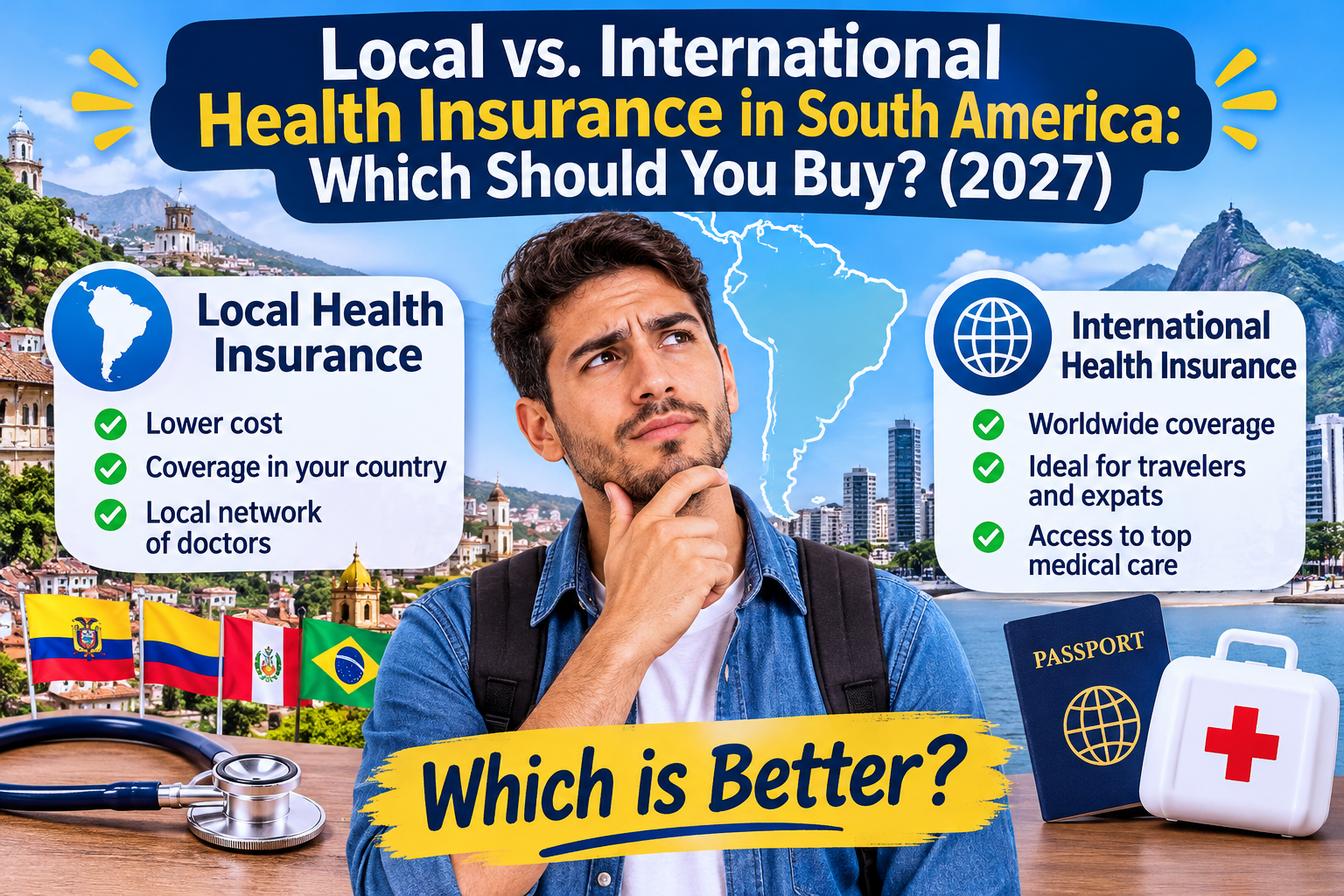
When Americans move to South America, the health insurance decision usually comes down to two very different products. A local plan from a company in your new country can cost less than $100 a month. An international plan from a global insurer can cost five to ten times as much. Both are called “health insurance,” but they protect you against very different risks.
The cheaper option is not automatically the smart one, and the expensive one is not automatically better. The right answer depends on your age, your country, how often you travel, whether you want access to US care and how much financial risk you can absorb. This guide breaks down what each type covers, what it costs for 2027, how the rules differ from Ecuador to Brazil, and the combined strategies that many expats use.
The short answer: A local plan is usually the best value for everyday care if you are under 60, settled in one country and comfortable with local hospitals. An international plan makes more sense if you are older and need guaranteed renewal, travel often, want coverage in the US or need high limits for serious illness. Many expats end up with a hybrid: the public system or a local plan for routine care, plus an international plan, high-deductible policy or evacuation membership for catastrophic events.
The Three Options, Explained
In most South American countries you are really choosing among three layers, not two.
1. The public or social security system
Most countries let legal residents join a public system: IESS in Ecuador, an EPS in Colombia, EsSalud or SIS in Peru, FONASA in Chile and Uruguay, SUS in Brazil. In Chile, for example, Fonasa accepts every legal resident with a RUT, regardless of age or pre-existing conditions (Expat.cl). In Brazil, the SUS is free for all residents, including foreigners (The Rio Times).
- Pros: cheapest, no age limits, usually covers pre-existing conditions.
- Cons: waiting lists, crowded facilities, little English, coverage only inside the country.
2. Local private insurance
These are plans from insurers based in your country: medicina prepagada in Ecuador and Colombia, Rimac or Pacífico in Peru, an Isapre in Chile, a mutualista in Uruguay, a prepaga in Argentina, a plano de saúde in Brazil.
- Pros: affordable, access to the better private clinics, local claims handling and direct billing.
- Cons: coverage limited to that country (sometimes with a small travel benefit), entry age limits, waiting periods, exclusions for pre-existing conditions, annual limits that can be low, and Spanish or Portuguese contracts.
3. International health insurance
These are global policies from insurers such as Cigna Global, Allianz Care, GeoBlue, Bupa Global or IMG. Cigna’s annual limits, for example, run from $1 million (Silver) to unlimited (Platinum), with a cheaper Close Care option limited mostly to your country of residence (Pacific Prime).
- Pros: high limits, coverage in several countries, optional US coverage, English-language service, medical evacuation, guaranteed renewal with many insurers.
- Cons: much higher premiums, medical underwriting at entry, frequent need to pay first and claim later, and premiums that rise steeply with age.
Important: international health insurance is different from travel insurance. Travel medical plans cover short trips and emergencies, not long-term residence, and are usually not accepted for residency visas.
Side-by-Side Comparison
| Feature | Local private plan | International plan |
|---|---|---|
| Typical monthly cost, age 50–60 | ~$60–200 | ~$300–700+ |
| Typical monthly cost, age 65–75 | ~$100–400, if you can enroll | ~$600–1,500+ |
| Where it covers you | Mainly one country | Region or worldwide, US optional |
| Annual limit | Often $20,000–$500,000 | Often $1M to unlimited |
| Maximum entry age | Often 60–70 (varies) | Some insurers have no upper age; others stop around 74–75 |
| Pre-existing conditions | Often excluded or waiting periods | Underwritten; may be excluded |
| Paying for care | Direct billing at network clinics | Direct billing for large bills; reimbursement for smaller ones |
| Medical evacuation | Rarely included | Usually included or available |
| Language | Spanish or Portuguese | English |
| Accepted for residency visas | Usually yes (check rules) | Usually yes, if it states local coverage |
Ranges are approximations for 2027 planning based on published market ranges and expat reports. Your quote depends on age, country, deductible and health history.
What the local numbers look like
- Uruguay: a mutualista typically costs about $90–140 per adult per month, though reports vary (The Rio Times). Premium private plans cost roughly $325–400+ and often only accept people under 60 (Out of Your Comfort Zone).
- Chile: a single person typically pays about CLP 80,000–150,000 a month for an Isapre (Expat.cl), roughly $85–160.
- Peru: local plans from Rimac, Pacífico or Mapfre range from about $40–110 a month for basic cover up to $80–180 for comprehensive cover (Armenian Lawyer), rising with age.
- Brazil: planos de saúde run roughly BRL 300–2,000 a month, about $55–370, depending on age, city and tier (Feather).
- Ecuador and Colombia: prepagada plans for people over 60 often fall in the $150–250+ range; see our country guides for details.
What the international numbers look like
The average international private medical policy in Peru has been estimated at about $4,213 a year for an individual (Movehub), about $350 a month. That is an average across ages; someone over 65 choosing worldwide coverage including the US will usually pay much more.
[Affiliate button: Compare international health insurance quotes]
Country by Country: What Works Where
The local-versus-international decision changes a lot depending on the country, mainly because of age rules and public-system access.
Ecuador
Legal residents can join IESS by paying 17.6% of a declared income base, with a 2026 minimum of about $84.83 a month. Routine care starts after three consecutive contributions; emergencies are covered from day one. Local prepagadas often have entry age limits and pre-existing condition exclusions. Common strategy: IESS as a base, plus a local prepagada if you can still enroll, or an international plan if you want care in private hospitals without age-related surprises.
Colombia
Some residents can join the EPS system, but holders of the Pensionado (retirement) visa can’t use an EPS, and their insurance must cover the risks listed in Resolution 5477. Prepagada plans for people over 60 often cost $150–250+ a month. Common strategy: prepagada if accepted; international plan if you are older or already have health issues.
Peru
EsSalud is compulsory for people working in Peru, while SIS is available to some people who are not working, on low incomes or retired (Expatriate Healthcare). Expat reports suggest some local insurers accept new members up to about age 65 with lifetime renewal, but check current rules. Common strategy: a local Rimac or Pacífico plan in Lima, with evacuation cover if you live outside the big cities.
Chile
If you have residency and a RUT, 7% of taxable income goes to Fonasa or an Isapre. Isapres can decline applicants or price based on age, sex and pre-existing conditions, though the Ley Corta limits some practices for plans signed after September 2024 (Migaku). Some expats find Isapre premiums unaffordable in their 50s and 60s and switch to Fonasa or international cover (Expat.cl). Common strategy: Fonasa as a guaranteed base, with international cover or a top-up for private clinics.
Uruguay
Mutualistas are the most common choice for expats: a monthly fee buys access to that institution’s hospitals and doctors, with co-pays for visits and medicines. Some charge entry fees or limit new members by age. Common strategy: a mutualista for daily care, plus an international or catastrophic plan for evacuation and care abroad.
Argentina
Prepagas can’t reject applicants because they are over 65, and the oldest age band can cost at most three times the youngest. That makes local cover unusually accessible for retirees. Inflation and frequent price adjustments are the main risk. Common strategy: a local prepaga, with an international plan only if you travel a lot or want US coverage.
Brazil
Plans sold since 2004 use ten age bands, and the top band, 59 and older, can cost at most six times the first (The Rio Times). Private plans can’t refuse older applicants, but pre-existing conditions can carry a waiting period of up to 24 months. Common strategy: a plano de saúde in a major city if you speak some Portuguese; international cover if you don’t or you want care outside Brazil.
| Country | Public system open to resident expats? | Local plan friendly to retirees? |
|---|---|---|
| Ecuador | Yes (IESS) | Limited by age |
| Colombia | Yes, except Pensionado visa holders | Limited by age |
| Peru | Limited (EsSalud if working, SIS in some cases) | Some accept up to ~65 |
| Chile | Yes (Fonasa) | Isapres can price by age |
| Uruguay | Yes (ASSE/FONASA) | Mutualistas, some age limits |
| Argentina | Yes, public hospitals | Yes, can’t reject over 65 |
| Brazil | Yes (SUS) | Yes, with pricing caps |
From the Ground
[Optional, 150–300 words: your own experience or that of an expat you know in Ecuador comparing a local prepagada with an international plan, including real prices and how claims worked.]
Hybrid Strategies Most Expats Use
You don’t have to choose only one. These combinations cover most situations:
| Strategy | What it combines | Approx. monthly cost, age 60–65 | Best for |
|---|---|---|---|
| Budget base | Public system + evacuation membership | ~$100–150 | Tight budgets, healthy retirees |
| Local plus | Local private plan + evacuation membership | ~$150–350 | Settled in one country, under ~65 |
| Catastrophic shield | Public or local plan + high-deductible international plan | ~$250–500 | Want protection against big bills without full premiums |
| Full international | Comprehensive international plan, optional US coverage | ~$600–1,500+ | Frequent travelers, older expats, people who want US care |
Approximations for planning; get real quotes before deciding.
Why the “catastrophic shield” works
Everyday costs in South America are low: a specialist visit at a private clinic might cost $40–100. What can ruin you is a cancer diagnosis, a heart surgery or an evacuation, which can cost tens of thousands of dollars. A high-deductible international plan (for example, a $5,000 or $10,000 deductible) can cost much less than a full plan while still protecting you against those events. You pay routine costs out of pocket or through the local plan.
How to Decide: A 5-Question Test
- How old are you, and how long will you stay? If you are close to the entry age limit of local plans, decide now. Waiting can lock you out.
- Do you have pre-existing conditions? Public systems (and, in Argentina and Brazil, private plans) can be more forgiving. International plans may exclude them.
- How often do you travel? If you split time between countries or visit the US for long periods, local plans won’t follow you.
- Do you want access to US care? Only international plans with US coverage (or Medicare if you return) provide that.
- What is your maximum tolerable loss? If a $50,000 bill would wreck your finances, you need catastrophic protection, local or international.
A quick decision table
| Your profile | Suggested approach |
|---|---|
| 55, healthy, settled in Lima | Local plan + evacuation |
| 63, Cuenca, IESS member, moderate budget | IESS + high-deductible international or evacuation |
| 68, travels between Montevideo and the US | International plan with US coverage, or mutualista + travel plan + Medicare |
| 70, Buenos Aires, on a budget | Local prepaga |
| 72, chronic condition, Medellín, Pensionado visa | Check if any prepagada accepts you; otherwise an international plan that meets the visa rules |
[Affiliate button: Get a quote for a high-deductible international plan]
Frequently Asked Questions
Is local health insurance in South America good enough?
For routine care, often yes, especially in capitals like Lima, Santiago, Bogotá, Montevideo, Buenos Aires and São Paulo, where the best private hospitals are excellent. The gaps are usually annual limits, care outside the country and evacuation.
Can I buy a local plan after age 65?
It depends on the country. Argentina and Brazil restrict rejecting older applicants. In Ecuador, Colombia and Peru, many local insurers set entry age limits, and in Chile Isapres can price heavily by age. Ask each insurer for its current maximum entry age before you move.
Does international insurance cover me in the US?
Only if you choose a plan or option that includes the US. Worldwide-excluding-US plans are much cheaper. If you keep Medicare, some expats choose international plans without US coverage.
Will a local plan satisfy residency visa requirements?
Usually yes, if it meets the country’s rules. Ecuador, for example, requires coverage valid for the visa period, and Colombia’s Pensionado visa requires coverage of specific risks. Always check the current requirements.
Is the public system enough on its own?
For some budget-conscious retirees, yes, especially in Uruguay, Chile or Ecuador. But waits can be long and you have no coverage abroad. Adding an evacuation membership or catastrophic policy closes the biggest gap.
How do I compare quotes fairly?
Compare the annual limit, deductible, countries covered, pre-existing condition rules, maximum renewal age, waiting periods and whether evacuation is included, not just the premium.
Bottom Line
Local health insurance is the best-value choice for everyday care when you are relatively young, healthy and settled in one country. International insurance makes sense when you are older, travel often, want US coverage or need high limits and guaranteed renewal. For most expats, the strongest setup is a combination: a public or local plan for routine care plus catastrophic or evacuation protection for the events that can wipe out savings.
Decide before you hit local age limits, compare total coverage rather than price, and review your setup every year as your age and plans change.
Keep Reading
- Best International Health Insurance for Expats in South America (Article 29)
- Best Health Insurance for Expats Over 65 in South America (Article 27)
- Medical Evacuation Insurance for South America (Article 38)
- Healthcare in South America: Country Comparison (Article 19)
This article is for general information only and isn’t insurance, legal or financial advice. Premiums, age limits and rules change often and vary by insurer. Get written quotes and read the policy wording before you buy.
Sources
- Fonasa for Expats, Expat.cl
- Isapres in Chile, Expat.cl
- Healthcare Costs in Chile, Expat.cl
- Healthcare in Chile: Fonasa vs Isapre for Foreigners, Migaku
- Healthcare in Uruguay for Expats, The Rio Times
- Health Insurance and Migration for Expats in Uruguay, Out of Your Comfort Zone
- Health Insurance Peru, Expatriate Healthcare
- Healthcare for Foreign Residents in Peru, Armenian Lawyer
- Health Insurance Costs in Peru, Movehub
- Best International Health Insurance Plans for Expats in Peru, Pacific Prime
- Health Insurance in Brazil, Feather
- Brazil Education and Healthcare Explained, The Rio Times
- Healthcare in Brazil for Expats, The Rio Times
Deja una respuesta