
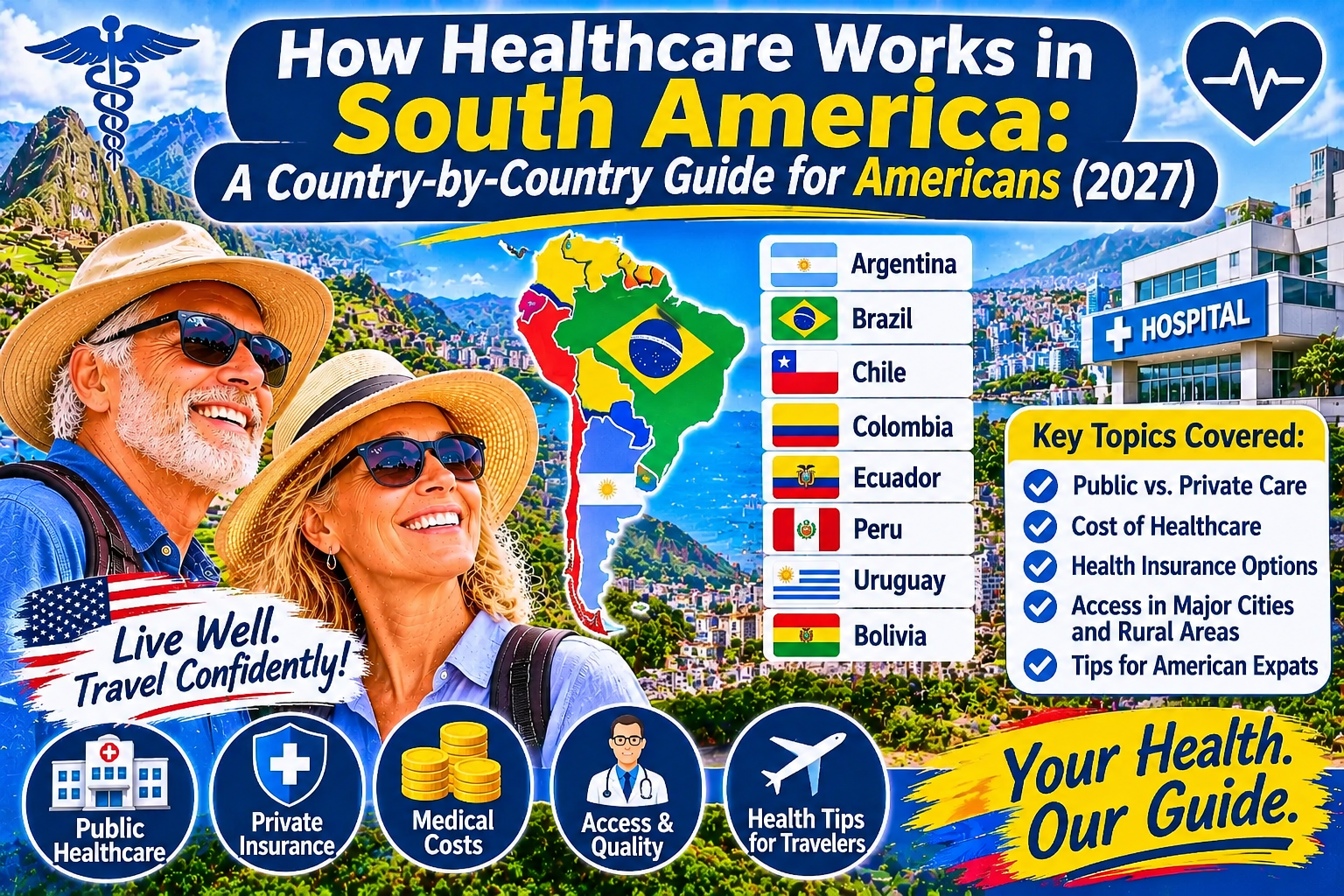
If you’re an American thinking about moving to, retiring in or spending long stretches in South America, health care is probably near the top of your list of worries. The good news is that most of the continent offers solid care at a fraction of US prices, and in several countries legal residents can join the national system for less than many Americans pay for a single month of insurance back home.
The catch is that every country works differently. Some systems are free for residents, some charge a percentage of your income, and at least one has started charging non-resident foreigners for hospital care. And almost none of them will help you until you have legal residency.
This guide walks through how health care works in seven countries Americans most often consider — Ecuador, Colombia, Peru, Chile, Argentina, Uruguay and Brazil — and what it means for you.
The Three Layers of Coverage
Across South America, health care for foreigners usually comes in three layers. Understanding them makes every country easier to figure out.
- The public system. Government hospitals and clinics, often free or very cheap. Usually open to legal residents; emergency care is generally provided to anyone. Quality varies widely, and wait times for non-urgent care can be long.
- Contributory or local private coverage. National insurance funds you pay into (such as Ecuador’s IESS, Colombia’s EPS or Chile’s FONASA), plus local private plans and prepaid medicine companies. Usually the best value for residents.
- International health insurance. Policies from global insurers that cover you across countries, often with the option to include the US. The most expensive layer, but the only one that works before you have residency and wherever you go.
Most Americans end up combining two of these layers — for example, a local plan for everyday care plus international coverage or an evacuation membership for major events.
Country Comparison at a Glance
| Country | Public system for legal residents | Main contributory or local option | What it typically costs a resident | Can tourists use public care? |
|---|---|---|---|---|
| Ecuador | Ministry of Health (MSP) hospitals, free | IESS voluntary affiliation | 17.6% of declared income, minimum ~$85/month | Emergency care, yes |
| Colombia | Subsidized regime for low-income residents | EPS (contributory regime) | 12.5% of 40% of income; floor | Emergency care, yes |
| Peru | MINSA hospitals and SIS for eligible groups | EsSalud (including the voluntary Potestativo plan) | Emergency care, yes | |
| Chile | FONASA | FONASA or private ISAPRE | 7% of taxable income; FONASA free for residents with no taxable income | Emergency care, billed afterward |
| Argentina | Public hospitals, free for residents | Obras sociales and private prepagas | Prepagas from ~ARS 100,000 to over 1 million/month | Emergencies only free; non-urgent care now billed at national hospitals |
| Uruguay | ASSE | Mutualistas | Mutualistas often ~$50–$150/month for non-FONASA adults; ASSE ~$60–$80 for retirees | Emergency care |
| Brazil | SUS, free | Private planos de saúde | Basic plans from ~R$200/month | Yes; SUS is free at the point of use |
Costs are approximate, vary by age, income and provider, and change often. The country sections below explain the details.
Ecuador
The short version: cheap, dollarized and expat-friendly, with a free public system, an affordable social security option for residents and good private hospitals in Quito, Guayaquil and Cuenca.
How it works
- Public system (MSP): the Ministry of Public Health runs hospitals and clinics that provide care free of charge. Emergency care is available to anyone. Quality is uneven, and non-urgent appointments can take a long time.
- IESS: Ecuador’s social security institute runs its own network of hospitals. Legal residents can join voluntarily, paying 17.6% of their declared income, with a monthly minimum of about $85 in 2026 (17.6% of the $482 basic salary). IESS covers a broad range of care and medication, including pre-existing conditions, but its hospitals can be crowded, and there’s an initial contribution period before you can use most benefits.
- Private care: private hospitals and clinics in the major cities offer quick appointments and English-speaking doctors at prices far below the US. Many expats pay out of pocket for routine care.
- Prepaid medicine (medicina prepagada) and local insurance: Ecuadorian companies sell plans that cover care at private networks. They’re relatively affordable but often impose age limits for new members and waiting periods for pre-existing conditions.
What Americans should know
- Your visa requires insurance. Ecuador’s temporary residence visas, including the pensioner and digital nomad visas, require national or foreign health insurance valid for the length of the visa.
- IESS is the classic expat value play. Many retirees combine IESS as a low-cost base with private care or an evacuation membership.
- Medicare doesn’t work here, but you can keep Part B active if you want to protect your options for returning to the US.
For the full details, see our guides to Ecuador’s residency requirements and IESS for expats.
Colombia
The short version: some of the best hospitals in Latin America, especially in Medellín and Bogotá, plus an insurance system that legal residents can join for a percentage of their income.
How it works
- Contributory regime (EPS): residents with income pay into an EPS, a health promotion company that manages their care. Self-employed and independent contributors pay 12.5% of a contribution base equal to 40% of their income, with a floor tied to the minimum wage of about COP 218,900 (~$69) a month in 2026. Coverage includes pre-existing conditions.
- Subsidized regime: for low-income Colombians and residents. Rarely relevant for Americans.
- Prepaid medicine (medicina prepagada): private plans that sit on top of the EPS and offer faster access to specialists and private clinics. Many expats use EPS plus prepagada.
- Private pay: consultations and procedures at private clinics are affordable by US standards, which is why Colombia is a major medical tourism destination.
What Americans should know
- Your visa type matters. Joining an EPS requires residency and a cedula de extranjería, and some visa categories, including the pensioner visa, face restrictions. Check before you count on EPS coverage.
- The EPS system has been under financial strain, with government interventions at several large EPSs in recent years. Expats often report delays getting specialist appointments, which is one reason prepagada plans are popular.
- Visa insurance rules are strict. The digital nomad visa requires coverage for accident, illness, maternity, disability, hospitalization, death and repatriation.
For more, see our guides to Colombia’s visas and health insurance and the cost of health care in Colombia.
Peru
The short version: good private clinics in Lima, much thinner care elsewhere, and a voluntary social security plan that residents can buy at a flat monthly rate.
How it works
- Public system (MINSA): Ministry of Health hospitals and clinics serve the general population, and the SIS (Integral Health Insurance) program mainly targets low-income Peruvians without other coverage. Facilities outside Lima can be basic.
- EsSalud: Peru’s social security health system. Employees are enrolled through their employers. Residents without a job can buy into EsSalud Potestativo, a voluntary plan with flat monthly premiums that rise by age band — roughly S/132, S/138 or S/215 a month (about $38 to $61). It comes with waiting periods and limits on pre-existing conditions.
- Private clinics and EPS plans: Lima’s private clinics are where most expats go. Peruvian private insurers and EPS plans cover care at those networks.
What Americans should know
- Location matters more than anywhere else on this list. Lima has excellent private care; Cusco handles common problems but sends serious cases to Lima; smaller towns and the Amazon have very limited care.
- Altitude is a health factor. Cusco, Arequipa and Puno are all at high elevation, which matters if you have heart or lung conditions.
- The rentista visa requires $1,000 a month in income, plus $500 for each dependent. Sources disagree on whether it formally requires health insurance, so confirm with Peru’s immigration office before applying.
For details, see our guides to Peru’s rentista visa and to comparing Ecuador and Peru for retirees.
Chile
The short version: the most developed health care system on this list, with a mandatory 7% contribution that legal residents direct either to the public fund or to a private insurer.
How it works
- The 7% rule: workers, and many pensioners, pay a mandatory 7% health contribution on taxable income. It goes to FONASA by default unless you choose a private ISAPRE. In 2026, the taxable ceiling for the contribution is 87.8 UF a month.
- FONASA: the public fund covers most of the population, assigns members to groups based on income and has been free at the point of use for members since September 2022. Legal residents with no taxable income may qualify for free coverage in Group A.
- ISAPREs: private insurers that use your 7%, plus any extra premium, to buy a private plan. They price by individual risk and use health declarations, so pre-existing conditions and age can mean surcharges.
- GES/AUGE: a list of conditions with guaranteed coverage, timelines and maximum out-of-pocket costs, available through both FONASA and ISAPREs.
- Emergencies: everyone, including tourists, is treated first and billed afterward.
What Americans should know
- There’s no Medicare or reciprocal agreement, so you rely on FONASA, an ISAPRE or international insurance.
- Retirees on foreign pensions often find FONASA much cheaper than an ISAPRE, especially after 60.
- Professional salaries and ISAPREs: with income above roughly CLP 1 million a month, many expats find the same 7% buys better access through an ISAPRE.
See our country comparison of Uruguay, Chile and Argentina for more.
Argentina
The short version: Argentina’s famously free public hospitals now come with conditions for foreigners. Residents still have access, but non-residents pay for non-urgent care at national hospitals.
How it works
- Public hospitals: free for Argentine citizens and residents. Emergency care can’t be denied to anyone, regardless of immigration status.
- Obras sociales: employment-linked health funds that cover workers and their families.
- Prepagas: private health plans from companies like OSDE, Swiss Medical, Galeno and Medicus. Monthly fees ranged from about ARS 100,000 to more than ARS 1 million in 2026, depending on age and plan.
What changed for foreigners
- May 2025: Decree 366/2025 amended the migration law and ended the unconditional right of every foreigner to free public health care. It also made health insurance a requirement for non-resident foreigners entering the country.
- August 2026: Resolution 1066/2026 began implementing the change. Hospitals run by the national government now charge foreigners without permanent residency for non-urgent care, or bill their insurance.
- The scope is limited: the national rule applies only to hospitals run by the national government. Most public hospitals are provincial or municipal, but some provinces, including Salta, Jujuy, Santa Cruz and Mendoza, already charge non-residents, and Buenos Aires city hospitals require residency documentation for free care.
What Americans should know
- Permanent residents keep full access. Reports differ on how temporary residents are treated in practice, so carry insurance until you have permanent residency.
- Travel insurance matters again. Visitors should carry a policy that covers treatment, hospitalization and repatriation in Argentina.
- Inflation affects prices. Prepaga fees adjust frequently, so budget for increases.
Uruguay
The short version: a stable, well-organized system where most people belong to a nonprofit health cooperative called a mutualista, and legal residents can join one for a modest monthly fee.
How it works
- FONASA and the SNIS: Uruguay’s National Integrated Health System is funded mostly through FONASA payroll contributions of 3% to 8%. Formal workers and their families are assigned to a mutualista or to ASSE through FONASA, typically without a separate premium.
- Mutualistas: nonprofit health cooperatives that provide most of the country’s care. Expats without FONASA coverage pay a monthly fee directly. Estimates vary by provider and age, but direct mutualista fees for adults are commonly reported around UYU 2,100 to 2,500 a month (about $51 to $61) in Montevideo, with many expat guides quoting $70 to $150 or more for older members.
- ASSE: the public provider. Legal residents can enroll, and retired expats can get full coverage for around $60 to $80 a month, typically without copays, though waits are longer.
- Private premium plans: higher-end private insurers charge more, often $325 to $400 or more a month, and usually set age limits for new members.
What Americans should know
- Expect copays at mutualistas for visits, tests and medications, on top of the monthly fee.
- Age limits: some mutualistas and premium plans restrict new members over a certain age. Join early if you can.
- Switching window: FONASA members can change mutualistas more easily during an annual window, usually in February.
Brazil
The short version: a huge, free public system open to everyone, plus a large private insurance market that most expats use for faster access.
How it works
- SUS: Brazil’s Unified Health System is guaranteed by the 1988 Constitution and free at the point of use. Residents with a CPF register at a local basic health unit (UBS) and get a national health card. Emergency care through SUS and the SAMU ambulance service is available to anyone.
- Planos de saúde: private health plans regulated by the ANS. About 53 million people had private medical plans in August 2026, roughly one in four Brazilians. Major companies include Bradesco Saúde, SulAmérica, Amil and Unimed.
- Farmácia Popular: a government program that provides a list of common medicines for free.
What Americans should know
- SUS is genuinely free, but crowded. Primary care is a strength; waits for specialists and elective surgery can be long.
- Most expats carry a private plan. Basic plans start around R$200 a month, with premium plans running R$1,200 to R$4,200 or more.
- Private plans usually require a CPF and may impose waiting periods for pre-existing conditions.
- The digital nomad visa requires health insurance valid in Brazil for your entire stay.
What Medicare Does and Doesn’t Do in South America
This is one of the most common questions we get, so here’s the short version:
- Original Medicare generally doesn’t pay for care outside the US. That’s true in every country on this list.
- Medigap’s foreign travel benefit is limited. Plans C, D, F, G, M and N pay 80% of emergency care abroad after a $250 deductible, only during the first 60 days of a trip, up to a $50,000 lifetime maximum. That’s a travel safety net, not coverage for living abroad.
- Medicare Advantage plans usually cover only emergencies abroad, if anything.
- Keeping Part B still matters to many expats. If you drop it and re-enroll later, you can face a late enrollment penalty of 10% for each full 12-month period you went without it, for as long as you have Part B. In 2027, the standard Part B premium is $209.40 a month.
For the full analysis, see our Medicare guides: whether to keep Part B when you move abroad, how the late enrollment penalty works, and Medigap versus Medicare Advantage for Americans abroad.
How to Choose Your Coverage
The right setup depends on your age, health, budget and how settled you are. Here’s a practical way to decide.
Step 1: Are you a resident yet?
- No: you need private coverage — travel medical insurance for shorter stays or international health insurance if you’re settling in. Public and contributory systems are mostly off-limits until you have residency.
- Yes: look at the local contributory option first (IESS, EPS, EsSalud, FONASA, a mutualista or SUS). It’s usually the best value.
Step 2: How healthy are you?
- Pre-existing conditions: systems like IESS, Colombia’s EPS and Chile’s FONASA generally don’t exclude them the way private insurers can. That can make them the best or only option for older expats with chronic conditions.
- Healthy and under 60: you have more choices, including local private plans that may cap enrollment age.
Step 3: Do you need coverage outside the country?
Local plans stop at the border. If you’ll travel regionally or want care in the US, you’ll need an international plan, a travel policy for trips or both.
Step 4: What happens in a real emergency?
Local coverage won’t usually fly you home. Consider a medical evacuation membership if you’d want treatment in the US after a serious event.
Five Practical Tips
- Get your residency paperwork in order early. Your cedula, CPF, RUT or DNI is the key that unlocks most local systems.
- Learn the waiting periods. Contributory systems and local private plans often require a few months of payments before you can use most benefits.
- Join before the age limits. Many private plans and some cooperatives stop accepting new members at 60, 65 or 70.
- Keep emergency cash or a credit card. Even where care is free, private clinics may ask for a deposit before admission.
- Pick your doctor, not just your plan. Ask other expats for English-speaking doctors and the hospitals they trust; a good local doctor can help you navigate any system.
From the Ground
[Optional, 150–300 words: your own experience with health care in Ecuador — a visit to a public hospital, IESS or a private clinic, what it cost and how it compared with the US.]
Frequently Asked Questions
Can Americans use public health care in South America?
Usually only after getting legal residency, although emergency care is generally available to anyone. Brazil’s SUS is the most open, while Argentina now charges non-resident foreigners for non-urgent care at national hospitals.
Which South American country has the best health care for expats?
Chile, Colombia and Uruguay are often rated highly for quality, with Chile’s system the most developed overall. Ecuador and Colombia tend to offer the best value for retirees, especially through IESS or an EPS.
Do I need private health insurance if I live in South America?
Not always, but most expats carry something private, either local coverage for faster access or international insurance for care outside the country. Most residency visas also require proof of health insurance.
Does Medicare cover me in South America?
No. Original Medicare generally doesn’t cover care abroad, and Medigap’s foreign travel benefit is limited to emergencies during the first 60 days of a trip, up to $50,000 for life.
Do local systems cover pre-existing conditions?
Contributory systems like Ecuador’s IESS, Colombia’s EPS and Chile’s FONASA generally don’t exclude them, though waiting periods can apply. Private local plans and international insurers often exclude or surcharge them.
Is health care in South America really cheaper than in the US?
In most cases, yes, often dramatically. A specialist visit at a private clinic typically costs a fraction of US prices, and resident coverage through public or contributory systems can cost less than $100 a month.
Bottom Line
South America offers Americans good health care at prices that feel almost unbelievable after the US — but only if you match the system to your situation. Before residency, you’ll rely on private insurance. After residency, the best value is usually the local contributory system: IESS in Ecuador, an EPS in Colombia, EsSalud in Peru, FONASA in Chile, a mutualista in Uruguay or SUS in Brazil. Argentina is the exception to watch, now that non-residents pay for non-urgent care at national hospitals. Most expats add a private or international layer for faster access, travel and the scenarios local systems won’t cover.
Keep Reading
- Best International Health Insurance for Expats in South America (Article 29)
- How Much Does Expat Health Insurance Cost in South America? Prices by Age (Article 38)
- Should You Keep Medicare Part B If You Move to South America? (Article 12)
- Medical Evacuation Coverage for Americans in South America (Article 16)
- Our country guides for Ecuador, Colombia, Peru and Uruguay (Articles 1–10)
This guide is for general information only and isn’t medical, legal or insurance advice. Health care rules, eligibility and costs change often; confirm details with each country’s health authorities or a licensed advisor before making decisions.
Sources
- Chile FONASA and ISAPRE Systems Shape Healthcare Costs for Expats, The Rio Times
- Healthcare in Chile: Fonasa vs. Isapre for Foreigners, Migaku
- Healthcare in Chile, Expat.cl
- Chile Health Service, Expat Focus
- Milei Limits Free Hospital Care for Foreigners in Argentina, Buenos Aires Times
- Argentina Hospital Charges for Foreigners, The Rio Times
- Healthcare in Argentina for Expats 2026, The Rio Times
- Argentina Ends Free Healthcare for Foreigners, Buenos Aires Herald
- Healthcare in Uruguay for Expats, The Rio Times
- Cost of Living in Montevideo for Expats, The Rio Times
- Retire in Uruguay, The Rio Times
- Healthcare in Brazil for Foreigners, The Rio Times
- Brazil Education and Healthcare Explained, The Rio Times
- Health Care in Brazil, Expat.com
- Visa de Residencia Temporal Jubilado, Ecuador Ministry of Foreign Affairs
- Ecuador Digital Nomad Visa Requirements, Genki
- Colombia Digital Nomad Visa Guide, Genki
Deja una respuesta