
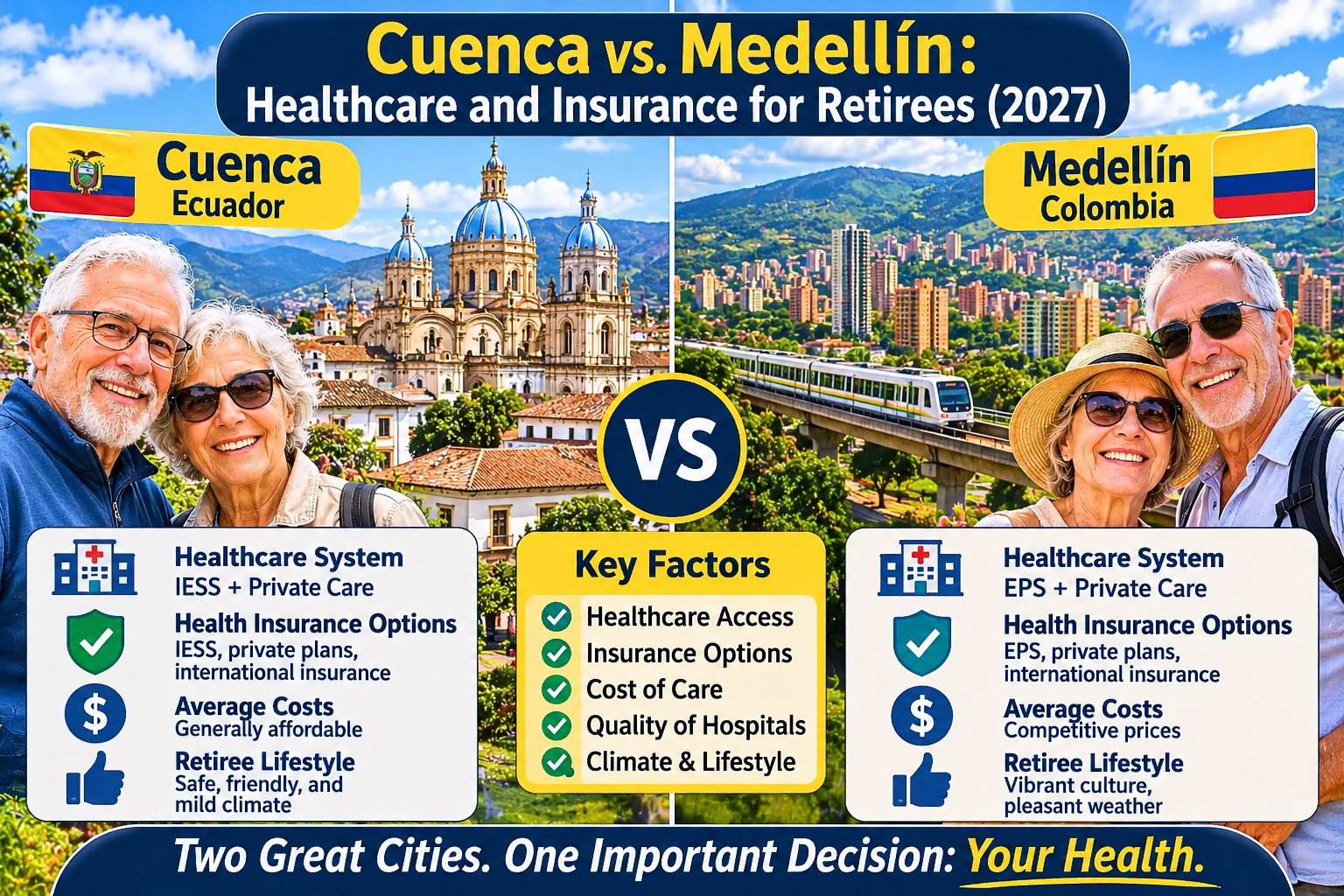
Cuenca and Medellín show up on almost every “best places to retire abroad” list, and for good reason. Both are mild, walkable cities with large American communities and costs that make a Social Security check go a long way. But when it comes to health care — the thing that matters more with every passing year — they’re surprisingly different.
Medellín has some of Latin America’s top-ranked hospitals and direct flights to the US. Cuenca is calmer and dollarized, and it offers retirees a cheap path into Ecuador’s social security health system. This guide compares the two on the factors that matter most for retirees.
The Short Answer
- Choose Medellín if hospital quality and quick access to the US are your top priorities. It has nationally top-ranked hospitals and an international airport with direct US flights.
- Choose Cuenca if you want the lowest-cost public coverage, a dollarized economy and a quieter city. Legal residents can join IESS for a monthly minimum of about $85, and pre-existing conditions are covered.
- In both cities, you’ll need private insurance for your visa. Neither country accepts its public system as proof of insurance for most residency visas.
Head-to-Head Comparison
| Factor | Cuenca, Ecuador | Medellín, Colombia |
|---|---|---|
| Altitude | About 2,560 m (8,400 ft) | About 1,495 m (4,900 ft) |
| Currency | US dollar | Colombian peso |
| Top hospitals | Good private hospitals (Hospital del Río, Monte Sinaí, Santa Inés); not in regional rankings | Hospital Pablo Tobón Uribe (No. 3 in Colombia), San Vicente Fundación (No. 8), Clínica Las Américas |
| Complex care | Some cases referred to Quito or Guayaquil | Most complex care available locally |
| Retiree visa income (2026) | $1,446 a month (pensioner visa) | COP 5,252,715 a month (pensionado visa; about $1,400–$1,660, depending on the exchange rate) |
| Visa health insurance | Required, valid in Ecuador for the visa period | Required, valid in Colombia; an EPS doesn’t satisfy it |
| Public or contributory coverage for retirees | IESS voluntary affiliation: 17.6% of declared income, minimum about $85/month | EPS: availability for pensionado visa holders is disputed |
| International flights | No international flights from Cuenca’s airport; fly via Quito or Guayaquil | Direct flights to several US cities from Rionegro (MDE) |
Hospitals and Medical Quality
Medellín: a regional medical hub
Medellín is one of Colombia’s leading medical cities and a major medical tourism destination. In Newsweek and Statista’s World’s Best Hospitals 2026 ranking for Colombia:
- Hospital Pablo Tobón Uribe ranks No. 3 in the country. It’s known for complex surgery, oncology and transplants, and it has an international patient office.
- Hospital Universitario San Vicente Fundación ranks No. 8, with a second campus in Rionegro, near the airport, ranked No. 11.
- Clínica Las Américas (Auna) ranks No. 17. It’s JCI-accredited, runs its own cancer institute and is popular with expats for complex procedures.
Medellín also has strong academic medicine, with major universities training many of Colombia’s specialists. For a retiree, that means most serious conditions — heart surgery, cancer treatment, joint replacements — can be handled locally.
Cuenca: solid care, fewer top-tier options
Cuenca has good private hospitals that serve its large American community, including Hospital Universitario del Río, Hospital Monte Sinaí and Hospital Santa Inés, along with a public hospital system and an IESS hospital. Routine care, common surgeries and emergencies are handled well.
What Cuenca doesn’t have is a hospital in the regional rankings. Ecuador’s top-ranked hospital, Hospital Metropolitano, is in Quito, and some highly specialized cases are referred to Quito or Guayaquil.
The verdict on hospitals
Medellín wins on depth and top-end quality. Cuenca is perfectly adequate for most retirees’ everyday needs, but if you have a complex condition that needs specialized care, Medellín puts it closer to home. For the full city-by-city picture, see our guide to the best hospitals for expats in South America.
Public Coverage: IESS vs. EPS
This is where the two cities differ the most for retirees, and where Cuenca has a real advantage.
Cuenca: IESS is open to residents
Once you’re a legal resident of Ecuador, you can join IESS, the country’s social security system, as a voluntary member. Key points:
- Cost: 17.6% of your declared income, with a monthly minimum of about $85 in 2026 (17.6% of the $482 basic salary).
- Pre-existing conditions: covered, which is rare in private insurance.
- No upper age limit to join as a voluntary member, which matters for retirees in their 70s.
- Trade-offs: an initial contribution period before you can use most benefits, crowded IESS hospitals and appointment waits.
Many retirees in Cuenca use IESS as an affordable base layer, then pay out of pocket for private specialists or keep a private plan for faster access.
Medellín: EPS access for retirees is complicated
Colombia’s contributory health system runs through EPSs, which independent contributors join by paying 12.5% of a base equal to 40% of income, with a floor of about COP 218,900 a month in 2026. Coverage includes pre-existing conditions.
The catch for retirees is the visa. Several immigration and health guides say that under Article 77 of Resolution 5477 of 2022, holders of the M-Pensionado visa are barred from joining Colombia’s social security system, including EPS. Others report pensionado holders enrolling in an EPS as independent contributors after getting their cedula. With sources in direct conflict, don’t count on EPS coverage on a pensionado visa until you’ve confirmed it with an immigration lawyer and the EPS itself.
Either way, many retirees in Medellín rely on private coverage: local medicina prepagada plans or international insurance. See our guide to Colombia’s visas and health insurance.
Visa insurance in both countries
Neither country lets you use its public system to satisfy the retiree visa’s insurance requirement:
- Ecuador’s pensioner visa requires national or foreign health insurance valid for the same period as the visa; a foreign policy must state that it covers you in Ecuador.
- Colombia’s pensionado visa requires private health insurance valid in Colombia, including repatriation, for the full visa period; immigration specialists stress that an EPS affiliation or a short travel policy won’t satisfy it.
The verdict on public coverage
Cuenca wins. IESS gives legal residents of any age an inexpensive path to coverage that includes pre-existing conditions, while EPS access for Colombian pensionado visa holders is uncertain at best.
Costs and Private Insurance
Out-of-pocket care
Both cities offer private medical care at a fraction of US prices. A specialist visit at a private clinic, routine lab work or an imaging scan typically costs far less than in the US in either city. For Colombian price examples, see our guide to the cost of health care in Colombia.
One structural difference: Ecuador uses the US dollar, so your costs don’t swing with exchange rates. In Colombia, prices are in pesos, which can work in your favor when the dollar is strong and against you when it weakens.
Private and international insurance
In both cities, you’ll need private coverage at least for your visa, and many retirees keep it for faster access to private hospitals:
- Local private plans: Colombian medicina prepagada and Ecuadorian prepaid medicine companies offer access to private hospital networks at relatively low prices, but they often set maximum enrollment ages and waiting periods for pre-existing conditions. Retirees in their late 60s or 70s may find options limited.
- International health insurance: more expensive but available at older ages from some insurers, portable between countries and sometimes able to include the US. See how much expat health insurance costs by age.
Realistic monthly health budget for a retiree
| Item | Cuenca | Medellín |
|---|---|---|
| Public or contributory coverage | IESS from about $85 | EPS uncertain on a pensionado visa |
| Private or international policy (needed for the visa) | Varies by age; get quotes | Varies by age; get quotes |
| Out-of-pocket care | Low | Low |
| Currency risk | None (US dollar) | Peso exposure |
Altitude: A Health Factor People Overlook
At about 2,560 meters (8,400 feet), Cuenca is significantly higher than Medellín, which sits at about 1,495 meters (4,900 feet).
Most healthy retirees adjust to Cuenca within days or weeks. But altitude can matter if you have heart disease, lung conditions like COPD, sleep apnea or certain blood disorders. Talk to your doctor before choosing a high-altitude city, and consider spending a few weeks there before committing. Medellín’s lower elevation is easier on most people.
Getting Home in an Emergency
If you’d want to return to the US for major treatment, access matters:
- Medellín: José María Córdova International Airport in nearby Rionegro offers direct flights to several US cities, including Miami. A medical escort or commercial repatriation is relatively straightforward.
- Cuenca: the city’s airport handles domestic flights only. Reaching the US means flying through Quito or driving about three to four hours to Guayaquil, which adds time to any evacuation.
In both cities, an evacuation membership can cover a flight home to a US hospital after you’re hospitalized. See medical evacuation coverage.
The verdict on access
Medellín wins on altitude and on quick access to the US.
Scorecard
| Category | Winner | Why |
|---|---|---|
| Hospital quality and depth | Medellín | Several nationally top-ranked hospitals |
| Affordable public coverage for retirees | Cuenca | IESS from about $85 a month, pre-existing conditions included |
| Currency stability | Cuenca | Ecuador uses the US dollar |
| Altitude | Medellín | Much lower elevation |
| Getting back to the US | Medellín | Direct US flights |
| Visa insurance requirement | Tie | Both require private coverage valid in the country |
Who Should Choose Which
Choose Medellín if…
- You have a complex or chronic condition that needs specialist care
- You want top-ranked hospitals within the city
- You may need to fly home quickly
- You have heart or lung issues that make high altitude a concern
- You can afford private or international insurance as your main coverage
Choose Cuenca if…
- You want the lowest-cost long-term coverage through IESS
- You have pre-existing conditions that private insurers would exclude
- You value a dollarized economy and a quieter, smaller city
- You’re comfortable traveling to Quito or Guayaquil for highly specialized care
Three Retiree Scenarios
The couple with a modest budget
Gary and Pam, both 68, live on about $3,000 a month in Social Security.
Likely better fit: Cuenca. After getting residency, both can join IESS at a low monthly cost, with pre-existing conditions covered. They keep a private policy as long as their visa requires it, and an evacuation membership for peace of mind.
The retiree with a heart condition
Linda, 71, had a cardiac stent placed two years ago.
Likely better fit: Medellín. The lower altitude is easier on her heart, Pablo Tobón Uribe and other top hospitals offer strong cardiology, and direct flights mean she can get home quickly. She’ll need international insurance that covers her condition, or must accept exclusions.
The active early retiree
Steve, 60, is healthy and plans to travel around South America.
Either city works. He should prioritize an international plan that covers him across countries. Medellín’s airport makes regional travel easier; Cuenca’s IESS option is a strong backup for later years.
Frequently Asked Questions
Is health care better in Cuenca or Medellín?
Medellín has deeper top-end care, with several of Colombia’s highest-ranked hospitals. Cuenca has good private hospitals for most needs, but some highly specialized cases go to Quito or Guayaquil.
Can retirees join public health care in Cuenca?
Yes. Legal residents of Ecuador can join IESS voluntarily, paying 17.6% of declared income with a monthly minimum of about $85 in 2026. Pre-existing conditions are covered.
Can retirees join an EPS in Medellín?
It’s unclear. Several sources say pensionado visa holders are barred under Article 77 of Resolution 5477, while others report retirees enrolling. Confirm with an immigration lawyer before relying on it.
Do I need private health insurance for a retiree visa in Ecuador or Colombia?
Yes, in both. Ecuador requires insurance valid in Ecuador for the visa period, and Colombia requires private insurance valid in Colombia, including repatriation; an EPS doesn’t satisfy Colombia’s requirement.
Is Cuenca’s altitude a problem for retirees?
For most healthy people, no. But at about 2,560 meters, it can be a concern for people with heart or lung conditions. Ask your doctor first.
Which city is easier for getting back to the US?
Medellín. Its international airport has direct US flights, while Cuenca’s airport handles domestic flights only.
Bottom Line
For health care, Cuenca and Medellín win in different ways. Medellín offers better hospitals, a lower altitude and direct flights home, making it the stronger choice for retirees with complex health needs and the budget for private insurance. Cuenca offers affordable, inclusive coverage through IESS and the stability of the US dollar, making it attractive for budget-conscious retirees and those with pre-existing conditions. Visit both, see a doctor in each and choose the city whose health care fits the next 10 to 20 years of your life.
Keep Reading
- Best Hospitals for Expats in South America, City by City (Best Hospitals for Expats in South America, City by City)
- Ecuador vs. Peru for American Retirees (Ecuador vs. Peru for Expats: Which Has Better Healthcare?)
- Colombia Visas and Health Insurance (EPS in Colombia for Foreigners: How to Enroll and What It Really Costs)
- The Cost of Health Care in Colombia (Cost of Healthcare in Colombia for Expats: Real Prices in Medellín and Bogotá)
- Medical Evacuation Insurance for Expats (Medical Evacuation Insurance for Expats: Getting Flown Home From South America)
This comparison is for general information only and isn’t legal, immigration or medical advice. Visa rules, social security eligibility and hospital rankings change; confirm details with official sources and qualified professionals.
Sources
- World’s Best Hospitals 2026: Colombia, Newsweek and Statista
- Colombia Healthcare for Foreigners: How EPS Works, Migaku
- Visa de Pensionado, Nexo Legal
- Visa Pensionado de Colombia, Colombia Move
- Visa Colombia jubilado o pensionado extranjero, Colombia Trámita
- Retire in Colombia 2026, The Rio Times
- Visa M Pensionado, Cancillería de Colombia
- Visa de Residencia Temporal Jubilado, Ecuador Ministry of Foreign Affairs
- Healthcare in Colombia for Expats 2026, Colombia Move
- Ecuador: List of Hospitals, UK Foreign Office
Deja una respuesta